
Every author reaches the same question before publishing: what will it cost? The answer to how much does it cost to publish a book is anywhere from $0 to more than $5,000. The final cost to publish a book depends on your publishing path, the services you choose, and how much you do yourself. Unless you have a hybrid publishing arrangement that costs you nothing, the money you’ll need will go toward editing, cover design, formatting, ISBNs, printing, and marketing.
While you can publish with Amazon Kindle Direct Publishing (KDP) without paying any fees to the platform, it may be worthwhile to invest in professional services to boost quality, credibility and visibility as a professional publisher.
The Australian Society of Authors Creator Income Survey (2025) showed that 60% of all authors who were paid an advance on publication made less than AU$5,000.
Instead of focusing on how expensive is it to publish a book, it’s better to learn the money spent on publishing a book and the services your book actually requires. Here is the full book publishing cost breakdown, a comparison between self-publishing and traditional publishing, some of the hidden costs that many first time authors may not think of, and some practical tips for achieving professional book publishing without going over budget.
Average Cost to Publish a Book (Quick Overview)
For most authors, the average cost of publishing a book falls between $500 and $5,000, but it can be cheaper or much more expensive depending on your publishing objectives. Writing a book is an expensive process, with a professionally produced book needing to invest in editing, cover design, formatting, ISBNs and marketing, while authors who do the work themselves can save a lot of cash.
The table below gives a realistic estimate of how much does publishing a book cost in 2026.
| Publishing Expense | Typical Cost (USD) | Is It Essential? |
| Developmental editing | $800–$3,000 | Optional (recommended for first-time authors) |
| Copyediting & proofreading | $300–$2,000 | Yes |
| Cover design | $50–$500+ | Yes |
| Book formatting | $50–$300 | Yes |
| ISBN | Free–$125 | Depends on your publishing platform |
| Print proof copies | $20–$150 | Recommended |
| Print on Demand setup | Usually free | Yes (for POD publishing) |
| Marketing & promotion | $100–$5,000+ | Strongly recommended |
Treat this table as the foundation of your publishing budget before comparing different publishing options.
Typical publishing budgets
Not every author needs the same budget. Most publishing projects fall into one of these categories:
| Budget | What You Can Expect |
| $0–$300 | DIY publishing using free tools and Amazon KDP |
| $500–$1,500 | Professional editing or cover design with limited marketing |
| $2,000–$5,000 | High-quality editing, professional design, formatting, ISBN, and launch campaign |
| $5,000+ | Premium publishing package with extensive editing, branding, and marketing |
If you have any doubts about how much would it cost to publish a book, keep in mind that each dollar spent will enhance the reader’s experience. Enlisting in the services of a professional editor or a good cover can reap a much bigger reward than spending a large sum on advertising. For guidance, you might want to hire a book publishing service that will help you plan and avoid expensive pitfalls.
Full Cost Breakdown of Publishing a Book
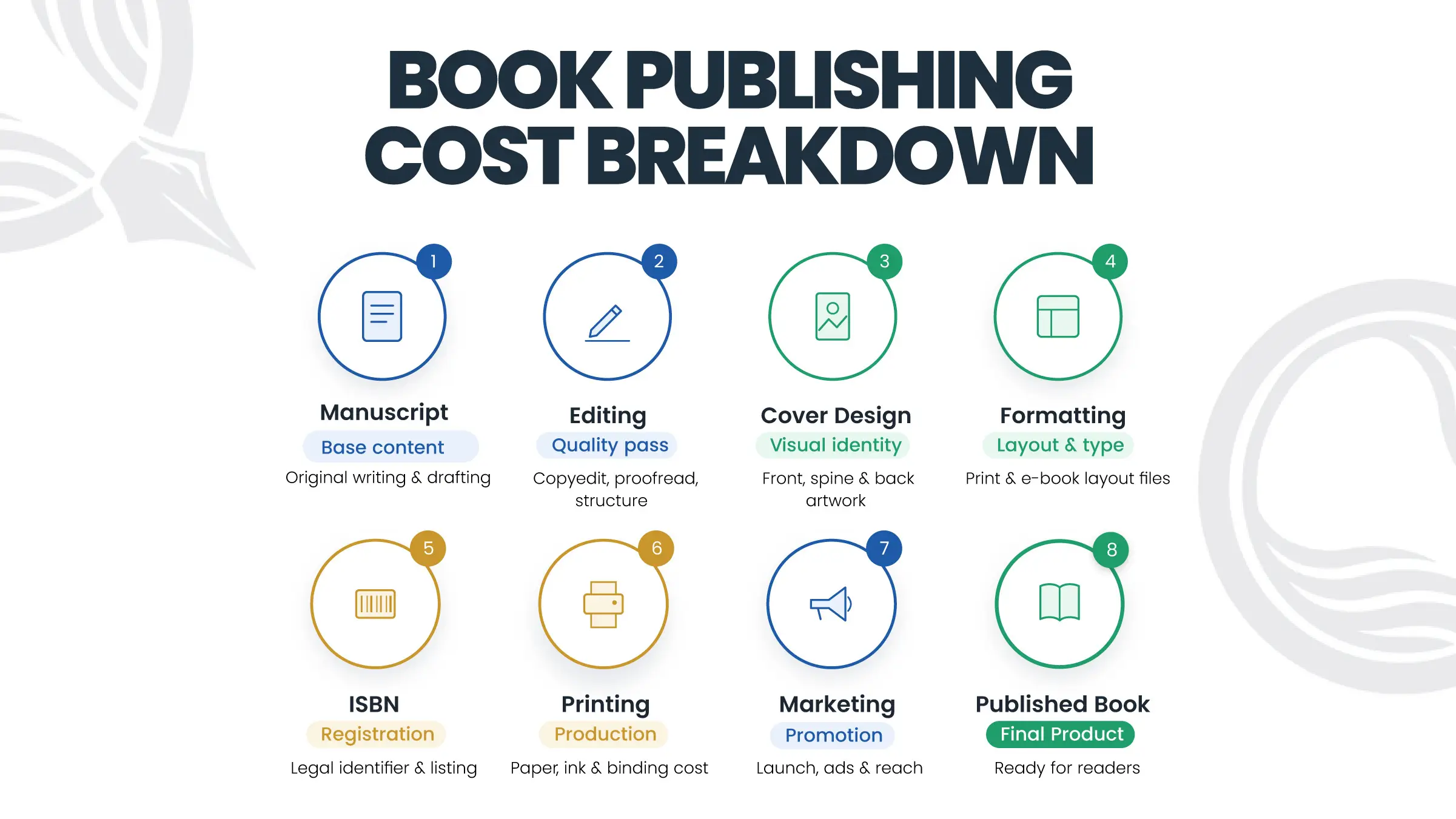
To discover how much does it cost to publish a book, you should consider each step individually. Book publishing cost breakdown covers the editing, cover design, formatting, printing, ISBN and marketing costs. Every stage will add to your overall publishing cost, and you can allocate your resources according to your objective.
Writing a professional book is not only about paying a big lump sum. Rather, your budget is divided into various phases, and each will lead to the quality of your final book. If you’re planning ahead, understanding this book publishing cost breakdown will help you decide where to invest and where you can save.
The most successful writers I’ve read have approached the publishing thing like a business investment, not just a one-time cost. Some books just require minimal proofreading and a professionally-produced cover, while others could benefit from development editing, custom graphics, and a higher marketing budget.
Let’s look at each cost in detail.
Editing Costs
Editing costs usually range from $300 to more than $3,000 depending on the type of editing you need. Most books require at least copyediting and proofreading before publication. A professionally edited manuscript improves readability, removes errors, strengthens your writing, and creates a far better experience for readers.
Many first-time authors underestimate the importance of editing because they’ve already revised their manuscript several times. However, even experienced writers rarely publish without professional feedback.
Editing is often the largest investment in a publishing budget. The Editorial Freelancers Association Rate Chart recommends rates ranging from $0.02 to over $0.08 per word, depending on the level of editing, helping explain why professional editing can cost anywhere from a few hundred to several thousand dollars.
There are three main types of book editing.
Developmental editing
Developmental editing focuses on improving your manuscript’s structure, pacing, organisation, chapters, arguments, character development, and overall content before line-level editing begins. It’s usually the most expensive editing stage because it involves extensive feedback.
Typical cost: $800–$3,000+
This service is especially valuable for novels, memoirs, business books, and first-time authors.
Copyediting
Copyediting improves sentence structure, grammar, consistency, punctuation, clarity, and style. It ensures your manuscript reads smoothly while maintaining your voice.
Typical cost: $300–$1,500
Proofreading
Proofreading is the final quality check before publication. It catches spelling mistakes, formatting inconsistencies, punctuation errors, and small issues that remain after editing.
Many manuscript editing services price proofreading by word count, making the proofreading cost per word an important factor when budgeting. Rates typically range from $0.01 to $0.04 per word, depending on the manuscript’s complexity and the editor’s experience.
Typical Editing Costs
| Editing Service | Average Cost |
| Developmental editing | $800–$3,000+ |
| Copyediting | $300–$1,500 |
| Proofreading | $200–$1,000 |
| Manuscript assessment | $300–$900 |
Money-saving tip: Before hiring an editor, ask for a sample edit. Many professional editors will review a few pages so you can assess whether their editing style suits your manuscript.
Cover Design Costs
Professional book cover design typically costs between $50 and $800+, depending on whether you hire a freelancer or an experienced designer. A high-quality cover can significantly improve your book’s sales potential.
A professionally designed cover influences whether someone clicks on your book, picks it up in a bookstore, or scrolls past it online. Even the strongest manuscript can struggle if the cover looks unprofessional.
If your budget is tight, you could create your own cover using design software or templates. However, unless you have graphic design experience, hiring a professional designer usually delivers better results.
Two popular platforms for finding experienced professional cover designers include:
- Fiverr for affordable freelance designers
- Reedsy for experienced publishing professionals
Prices vary depending on the designer, complexity, and whether you need an eBook cover only or a full paperback and hardcover package.
| Cover Option | Average Cost |
| DIY template | Free–$50 |
| Fiverr designer | $50–$300 |
| Professional designer | $300–$800+ |
| Premium illustrated cover | $800–$2,000+ |
If your book includes custom artwork, maps, or illustrations, your overall design costs will naturally increase.
Formatting & Typesetting Costs
Formatting and typesetting usually cost between $50 and $500, depending on whether you need eBook formatting, print formatting, or both. Professional formatting ensures your book looks polished across every format.
Once editing is complete, your manuscript needs to be professionally formatted. Professional book formatting services ensure your manuscript displays correctly across eBooks and printed editions.
Formatting ensures your book displays correctly on Kindle devices, tablets, smartphones, and printed pages. Poor formatting can create awkward spacing, inconsistent fonts, page breaks, and reader frustration.
Professional book formatting services generally include:
- Kindle formatting
- EPUB formatting
- Print-ready PDF creation
- Chapter styling
- Image placement
- Clickable table of contents
If you’re producing a printed book, you’ll also need professional typesetting to achieve clean page layouts.
The final typesetting cost depends on your book’s length and complexity. Books containing photographs, illustrations, tables, or diagrams usually cost more to format than text-only manuscripts.
| Formatting Service | Typical Cost |
| eBook formatting | $50–$150 |
| Print formatting | $100–$300 |
| Combined formatting package | $150–$500 |
Your typesetting cost may increase if your manuscript contains photographs, illustrations, tables, or complex page layouts.
If you’re planning to have your book typeset by a professional, ask whether revisions are included in the quoted price. Some providers charge additional fees for post-formatting changes.
One important consideration is ebook vs print cost. While eBooks require digital formatting only, printed books involve additional layout requirements such as margins, bleed, trim size, headers, page numbering, and spine calculations. These extra production steps explain why print formatting usually costs more than eBook formatting.
Why These Three Services Matter Most
If you’re working with a limited budget, prioritise these services in order:
- Professional editing
- Cover design
- Formatting
Together, they have the greatest impact on reader satisfaction, reviews, and long-term sales. You can often reduce marketing costs by publishing a polished, professional book that encourages readers to recommend it through word of mouth.
Printing Costs
Printing costs depend on your book’s page count, trim size, paper quality, and binding. Most self-published authors use Amazon Kindle Direct Publishing (KDP) or IngramSpark, both of which offer Print on Demand services. These platforms deduct printing costs from each sale rather than charging a large upfront printing fee.
Once your manuscript has been edited, designed, and formatted, the next expense is printing. Fortunately, authors today don’t need to order thousands of copies upfront. Thanks to Print on Demand (POD) technology, you can print books only when readers place an order, reducing financial risk and storage costs.
If you’re exploring how much does it cost to self publish a book, printing costs will depend on several factors, including your book’s page count, trim size, paper quality, ink type, and whether you publish in paperback or hardcover.
Paperback vs Hardcover Costs
One of the biggest decisions you’ll make is choosing between paperback and hardcover editions. When comparing hardcover vs paperback cost, paperbacks are generally much cheaper to produce and therefore offer higher margins for first-time authors. Paperback books usually cost $3–$7 per copy to print, while hardcovers often cost $8–$15 or more.
Paperbacks are more affordable to produce and usually attract a wider audience because of their lower retail price. Hardcovers, on the other hand, offer a premium reading experience and often command higher selling prices, making them popular for collector’s editions, business books, and gift titles.
| Format | Typical Printing Cost (USD) |
| Paperback (200–300 pages) | $3–$7 per copy |
| Hardcover (200–300 pages) | $8–$15+ per copy |
Your profit margin depends on both the printing cost and your chosen retail price.
Printing Cost Per Page
The printing cost per page increases as your manuscript grows longer. Books with colour interiors, photographs, or illustrations are significantly more expensive than standard black-and-white books.
The overall print on demand cost depends on factors such as page count, paper type, trim size, and colour printing.
Typical factors affecting printing costs include:
- Total page count
- Black-and-white or colour printing
- Paper quality
- Trim size
- Hardcover or paperback binding
- Print location
For example, a 120-page black-and-white paperback costs considerably less to print than a 350-page full-colour cookbook.
Print on Demand vs Offset Printing
For most first-time authors, Print on Demand is the most cost-effective option.
| Print Method | Best For | Upfront Cost |
| Print on Demand | New authors, small sales volumes | Very low |
| Offset Printing | Large print runs (500+ copies) | High upfront investment |
Offset printing reduces the cost per book when ordering in bulk, but it requires storing inventory and managing fulfillment. Unless you already have strong demand, Print on Demand is generally the safer choice.
If you’re publishing through Amazon KDP, uploading your files is free. You’ll only pay the printing cost after a copy sells, making it one of the easiest ways to start publishing without significant upfront expenses.
Although Amazon KDP is free to use, your overall production cost still depends on editing, formatting, cover design, and printing choices. If you need physical copies before launch, learn how to print author copies locally in Australia.
Marketing & Promotion Costs
Publishing your book is only the beginning. Readers can’t buy a book they never discover, which is why marketing deserves a dedicated place in your budget. Marketing costs typically range from $100 to more than $5,000 depending on your launch strategy. Most authors invest in advertising, reviews, websites, and ongoing book promotion after publication.
One of the biggest mistakes I see first-time authors make is spending most of their budget on production and leaving almost nothing for promotion. Even an outstanding book needs visibility to generate reviews, recommendations, and sales.
Your book marketing budget can vary dramatically depending on your goals. Some authors rely on organic promotion, while others invest heavily in advertising, publicity, and launch campaigns.
Common Book Marketing Expenses
A typical book promotion cost may include:
- Amazon Ads
- Facebook and Instagram advertising
- Book review services
- Email newsletter promotions
- Book launch events
- Influencer partnerships
- PR campaigns
- Author website development
Many authors also work with specialist book marketing agencies when launching a commercial title or building a long-term author brand. If you’re unsure where to begin, explore our book promotion and marketing services to build a strategy that fits your goals.
Amazon Book Advertising Cost
Amazon book advertising usually operates on a pay-per-click model, allowing authors to control their daily advertising budget. Many independent authors start with budgets of $5–$20 per day, increasing their spend once campaigns begin generating profitable sales.
If you’re publishing through Amazon, Amazon book advertising cost is usually based on a pay-per-click (PPC) model. You decide your daily budget, and you’re only charged when someone clicks your advertisement.
The success of Amazon Ads depends on:
- Relevant keywords
- Strong book descriptions
- Competitive pricing
- High-quality cover design
- Positive reader reviews
Advertising works best when the book itself is professionally produced. Driving traffic to an unedited manuscript or weak cover rarely delivers a good return on investment.
Typical Marketing Budget
Here is the typical marketing cost to publish a book:
| Marketing Activity | Average Cost |
| Amazon Ads | $100–$2,000+ |
| Social media advertising | $100–$1,500 |
| Book launch campaign | $200–$3,000 |
| Book review services | $50–$500 |
| Author website | $200–$2,000 |
Don’t Overlook Long-Term Marketing
A successful launch is important, but marketing shouldn’t stop after publication day.
I’ve found that authors who continue promoting their books through newsletters, blog content, podcast interviews, speaking engagements, and reader communities often achieve stronger long-term results than those who focus only on launch week.
Building an email list through a dedicated website for authors is one of the most valuable long-term marketing investments you can make. Unlike social media, you own your subscriber list and can communicate directly with readers whenever you release a new book.
If your budget allows, combining consistent content marketing with targeted advertising creates a more sustainable strategy than relying on paid ads alone.
Self-Publishing vs Traditional Publishing Cost
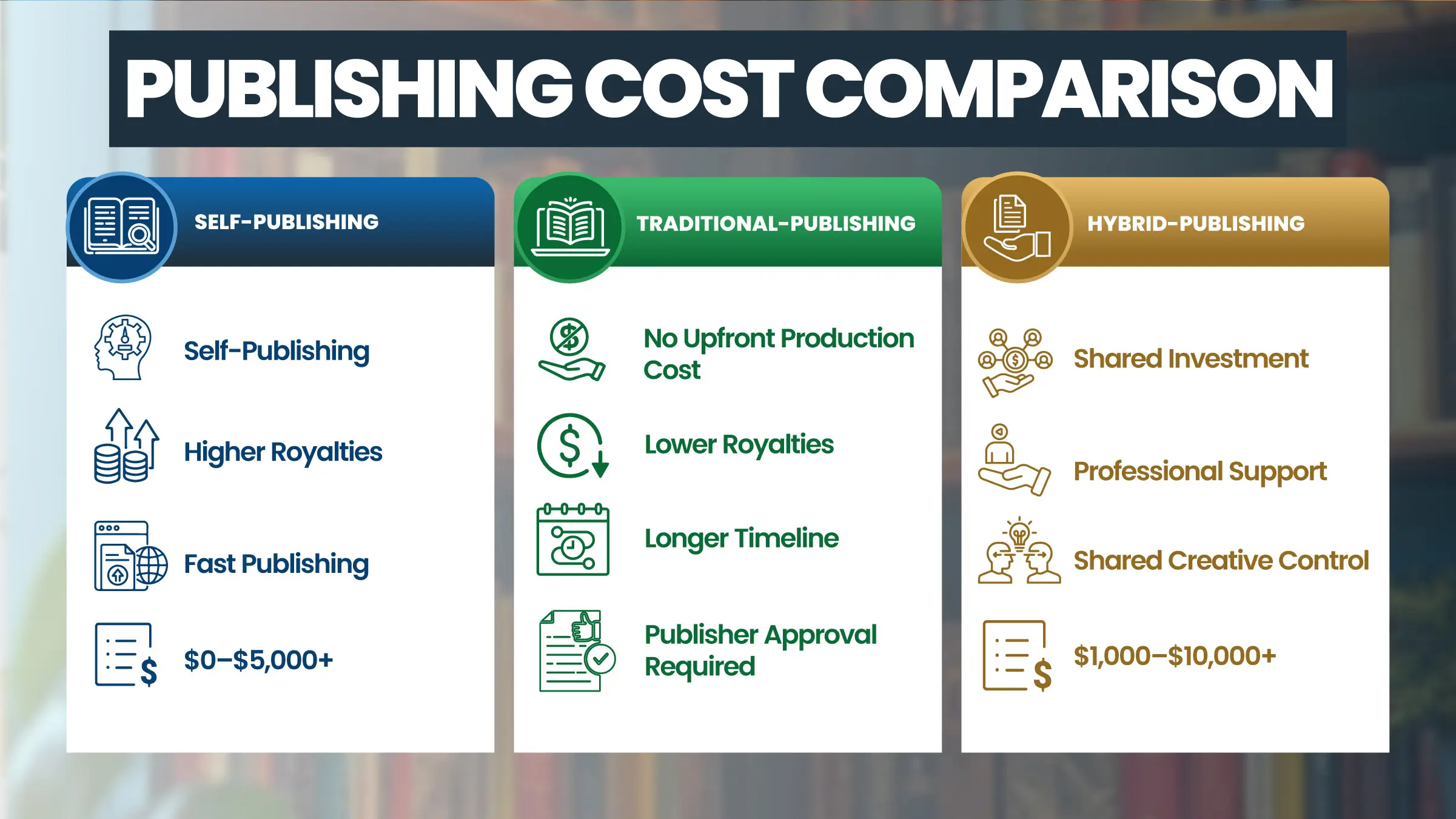
Understanding the self publishing vs traditional publishing cost difference helps you choose the publishing route that best suits your budget and goals. Self-publishing usually costs between $0 and $5,000+, while traditional publishing typically requires little or no upfront investment. The main differences are creative control, royalties, and who pays the production costs.
If you’re comparing your options, don’t just focus on the upfront investment. Consider your long-term goals, the support you need, and how you want your book to reach readers.
Here’s how the three main publishing models compare.
| Publishing Model | Typical Upfront Cost | Creative Control | Royalties | Best For |
| Self-Publishing | $0–$5,000+ | Full | Higher | Authors who want complete control and faster publishing |
| Traditional Publishing | Usually $0 | Limited | Lower | Authors seeking industry support and bookstore distribution |
| Hybrid Publishing | $1,000–$10,000+ | Shared | Varies | Authors who want professional assistance while retaining more control |
Self-Publishing Costs
If you’re asking how much does it cost to self publish a book, the answer depends entirely on the services you choose. Self-publishing costs usually range from $500 to $5,000 for a professionally produced book, although it’s possible to publish for less by handling some tasks yourself.
Publishing on platforms like Amazon Kindle Direct Publishing, IngramSpark, and Draft2Digital is either free or involves minimal platform fees. Instead of paying to upload your book, you’ll mainly invest in services that improve its quality, such as editing, cover design, formatting, and marketing.
Here’s a realistic estimate for a professionally self-published book.
| Expense | Typical Cost (USD) |
| Editing | $300–$3,000 |
| Cover design | $50–$500 |
| Formatting | $50–$300 |
| ISBN | Free–$125 |
| Marketing | $100–$5,000+ |
| Estimated Total | $500–$5,000+ |
One of the biggest advantages of self-publishing is flexibility. You decide where to spend your budget and when to invest. For example, some authors start with an eBook to reduce production costs, then release a paperback once they begin generating sales.
If I were publishing my first book with a limited budget, I’d prioritise professional editing and a strong cover before spending heavily on advertising. Readers may discover your book through marketing, but they’ll only recommend it if the quality meets their expectations.
Another benefit is speed. Self-publishing allows you to publish within days or weeks once your files are ready, compared with the much longer timelines often associated with traditional publishing.
Traditional Publishing Costs
Traditional publishing works very differently. In most cases, authors don’t pay upfront publishing costs. Instead, a publisher covers expenses such as editing, cover design, printing, distribution, and marketing. This is why many people assume traditional publishing is “free”.
While there are no direct production costs, acceptance is highly competitive. Most authors first need to secure a literary agent before submitting to publishers, and the process can take months or even years.
Traditional publishing also means giving up some creative control. The publisher usually decides elements such as:
- Cover design
- Publication schedule
- Pricing
- Distribution strategy
- Marketing direction
In return, authors receive Book Royalties, which are typically a percentage of each sale. Although the royalty rate is often lower than self-publishing, authors don’t need to fund production themselves.
Traditional publishing may be the right choice if your priority is wide bookstore distribution, industry recognition, and professional publishing support rather than complete creative control.
Hybrid Publishing Costs
Hybrid publishing sits between self-publishing and traditional publishing. The typical hybrid publishing cost ranges from $1,000 to more than $10,000, depending on the services included.
Instead of covering all costs themselves, authors share expenses with a publishing company that provides professional services throughout the publishing process.
A reputable hybrid publisher may offer:
- Professional editing
- Cover design
- Interior formatting
- ISBN registration
- Distribution support
- Marketing guidance
- Publishing consultation
While hybrid publishing can simplify the process, it’s important to research providers carefully. Be particularly cautious of companies that charge high vanity publishing fees while offering limited editorial support or distribution. Some companies offer genuine editorial and production expertise, while others charge premium fees without delivering meaningful value.
Before signing any agreement, ask questions such as:
- What services are included?
- Who owns the publishing rights?
- How are royalties calculated?
- Are there ongoing distribution fees?
- Can you choose your own editor or designer?
Taking time to compare providers will help you avoid unnecessary costs and ensure you’re investing in services that genuinely support your publishing goals.
Which Publishing Option Offers the Best Value?
There isn’t a single right answer. The best option depends on your budget, experience, and long-term objectives.
- Choose self-publishing if you want maximum creative control, higher royalty potential, and the flexibility to publish on your own schedule.
- Choose traditional publishing if you value industry support, established distribution networks, and don’t mind a longer publication process.
- Consider hybrid publishing if you want professional guidance while remaining more involved in publishing decisions.
Ultimately, the cost of publishing isn’t just about money, it’s about investing in the publishing path that gives your book the greatest chance of success.
Hidden Costs of Publishing a Book
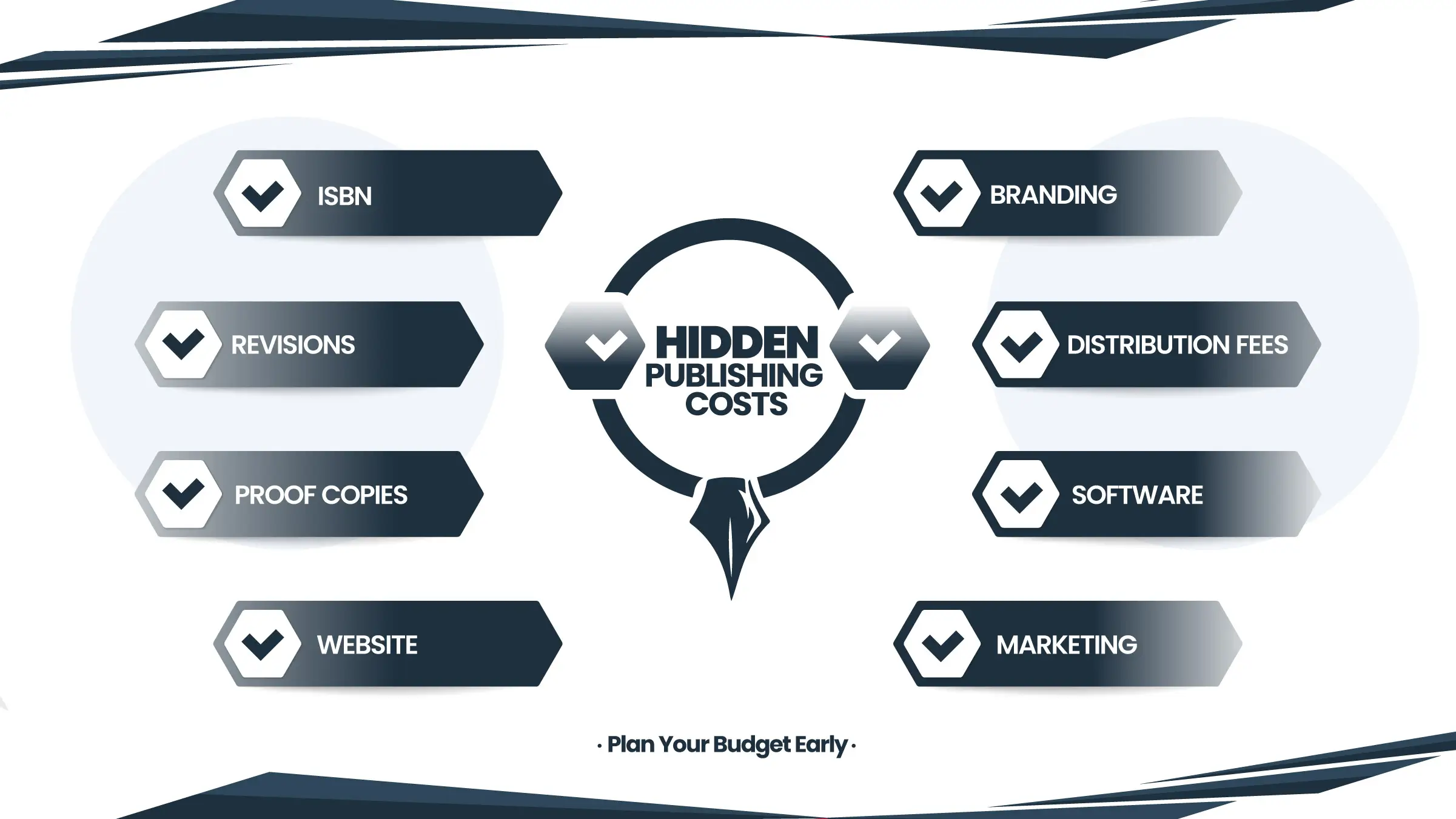
When authors ask me how much it would cost to publish a book, they’re usually thinking about editing, cover design, and printing. Those are the obvious expenses. However, there are several hidden costs that can quickly increase your budget if you don’t plan for them in advance. These often-overlooked publishing expenses can add hundreds or even thousands of dollars to your total budget. Hidden publishing costs include ISBN purchases, revisions, author branding, distribution fees, software subscriptions, and ongoing marketing. These expenses are often overlooked but can significantly increase your total budget.
The good news is that most of these costs are optional or can be managed with careful planning. Knowing what to expect means you can build a realistic budget and avoid unexpected surprises during the publishing process.
ISBN Purchase
An ISBN (International Standard Book Number) identifies your book and helps booksellers, libraries, and distributors track it.
If you’re publishing through Amazon Kindle Direct Publishing, you can use a free ISBN for your paperback in many regions. However, if you want to publish under your own publishing imprint or distribute your book more widely, purchasing your own ISBN may be worthwhile.
Typical cost: Free–$125 (depending on your country and ISBN provider)
While a free ISBN reduces upfront costs, owning your ISBN gives you greater control over your publishing brand and future editions.
Revisions and Rewrites
Very few manuscripts are ready after the first round of editing.
Once you receive editorial feedback, you’ll often need to revise chapters, rewrite sections, or update formatting. If you hire freelancers, these additional revisions may increase the total project cost.
To minimise unexpected expenses:
- Finish as much self-editing as possible before hiring an editor.
- Confirm how many revision rounds are included in your quote.
- Leave room in your budget for post-editing changes.
Planning for revisions from the beginning helps keep your publishing schedule on track.
Author Website and Branding
Publishing a book is only part of building an author career.
Many successful authors invest in a dedicated website for authors where readers can:
- Learn more about their books
- Join an email newsletter
- Read blog posts
- Contact the author
- Purchase books directly
Creating a simple website doesn’t have to be expensive, but you’ll usually need to budget for:
| Branding Expense | Typical Cost |
| Domain name | $10–$30 per year |
| Website hosting | $50–$200 per year |
| Website design | $0–$2,000+ |
| Email marketing software | Free–$50+ per month |
Owning your website also gives you greater control over your audience instead of relying entirely on social media platforms.
Distribution Fees
If you want your book available beyond Amazon, you may choose distributors such as IngramSpark or Draft2Digital.
While many platforms don’t charge large upfront fees, they may deduct a percentage of each sale or apply costs for optional services.
Examples include:
- Expanded distribution
- Print setup fees (where applicable)
- File revision fees
- International distribution charges
These distribution fees are easy to overlook but should be factored into your long-term publishing budget.
Software and Creative Tools
Many authors also purchase software while preparing their books for publication.
Common examples include:
- Writing software
- Design programs
- Formatting tools
- Stock photography
- Font licences
If your project includes custom artwork, maps, or children’s illustrations, you may also need professional illustration services, which can significantly increase production costs depending on the style and number of illustrations required.
Likewise, if you’re outsourcing the writing process, the ghostwriting cost can range from several thousand dollars to tens of thousands, making it one of the largest potential publishing expenses. While not every author needs this service, it’s worth including in your budget if you plan to hire a ghostwriter in Australia or elsewhere.
Hidden Costs Checklist
Before publishing, ask yourself whether you’ve budgeted this publishing expenses checklist:
- ISBN registration
- Additional editing revisions
- Proof copies
- Website and branding
- Distribution fees
- Software subscriptions
- Stock images or illustrations
- Marketing after launch
These smaller expenses may seem minor individually, but together they can add hundreds or even thousands of dollars to your total publishing budget.
The key takeaway is simple: don’t budget only for publishing your book. Budget for launching and supporting it as well.
Cost to Publish a Book on Amazon
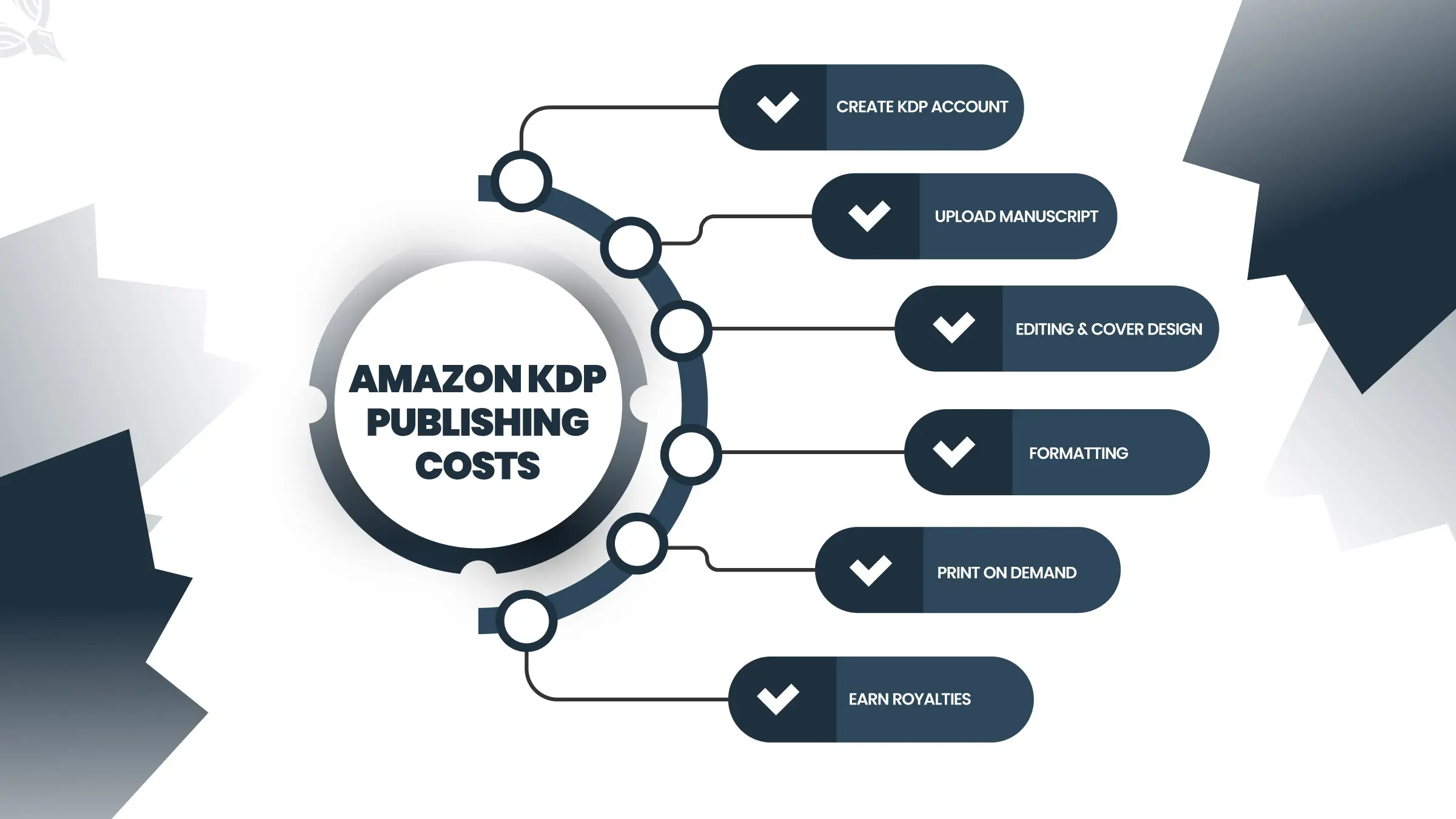
One of the most common questions authors ask is how much does it cost to publish a book on Amazon. While Amazon Kindle Direct Publishing (KDP) is free to use, professional publishing expenses still depend on editing, design, formatting, printing, and marketing.
However, “free to publish” doesn’t mean “free to produce.”
Your total investment still depends on the professional services you choose before clicking the Publish button. Thus, you’ll still need to budget for editing, design, formatting, printing, and marketing if you want a professional-quality book.
Although Amazon Kindle Direct Publishing (KDP) is free to use, authors can still earn up to 70% royalties on eligible eBooks while printing costs for paperbacks are deducted only after each sale through Amazon’s Print on Demand system, according to the Amazon KDP Help Centre.
Typical Amazon Publishing Costs
Here is the Typical Amazon Publishing Costs:
| Expense | Typical Cost |
| Amazon KDP account | Free |
| Manuscript upload | Free |
| eBook publishing | Free |
| Paperback setup | Free |
| Editing | $300–$3,000 |
| Cover design | $50–$500 |
| Formatting | $50–$300 |
| Marketing | $100–$5,000+ |
Amazon only deducts printing costs and royalties after each sale, making it an accessible option for first-time authors.
What Does Amazon Charge?
Amazon earns money by taking a share of each book sale rather than charging an upfront publishing fee.
Depending on your chosen pricing and distribution options, you’ll receive royalties after printing costs and Amazon’s commission have been deducted.
This means you can publish without a large initial investment while still maintaining control over your pricing, book updates, and publishing schedule.
Is Amazon KDP the Cheapest Option?
For many authors, yes.
Amazon KDP allows you to:
- Publish eBooks and paperbacks for free
- Update your manuscript whenever needed
- Reach readers worldwide
- Use Print on Demand to avoid holding inventory
That said, if your goal is to distribute widely to independent bookshops and libraries, many authors combine Amazon KDP with IngramSpark to expand their reach.
I’ve found that this combination often provides the best balance between Amazon visibility and broader distribution, especially for authors who want to build a long-term publishing business rather than simply release a single book.
Can You Publish a Book for Free?
Yes, you can publish a book for free. However, free publishing doesn’t mean you’ll automatically produce a book that readers are eager to buy.
Thus, knowing free vs paid publishing helps you decide which tasks you can handle yourself and where professional investment will have the greatest impact.
Platforms like Amazon Kindle Direct Publishing, Draft2Digital, and other self-publishing services allow you to upload your manuscript without paying an upfront publishing fee. If you’re comfortable handling every stage yourself, you could technically publish without spending any money.
The trade-off is that you’ll also take responsibility for editing, design, formatting, and marketing. Those are the areas that often separate a professional book from one that struggles to attract readers.
What Can You Do for Free?
If you’re working with a limited budget, you can reduce costs by using free tools and learning new skills.
Some common ways to publish for free include:
- Writing and self-editing your manuscript
- Designing a simple cover using free design tools
- Formatting your eBook with free software
- Publishing through Amazon KDP or Draft2Digital
- Promoting your book on social media and through your personal network
These steps can significantly lower your publishing expenses, especially if your goal is to test the market or publish a personal project.
Where Free Publishing Has Limits
While it’s possible to publish without spending money, some services are difficult to replace with DIY alternatives.
For example:
| Professional Service | DIY Option | Potential Trade-off |
| Professional editing | Self-editing | Missed errors and weaker readability |
| Custom cover design | Free templates | Less visual impact and lower click-through rates |
| Professional formatting | Free software | Inconsistent layout across devices |
| Paid marketing | Organic promotion | Slower visibility and fewer initial sales |
Readers may not know how much you spent publishing your book, but they can usually recognise the difference between a professionally produced title and one that hasn’t been properly edited or designed.
Where Should You Invest First?
If I had a very limited budget, I’d still invest in these services before anything else:
- Professional book editing and proofreading
- A professionally designed cover from experienced professional cover designers
- Basic formatting for print and eBook editions
Those three investments have the biggest impact on reader experience and book credibility.
Marketing can always be scaled over time, but it’s much harder to overcome poor reviews caused by avoidable production issues.
Free Doesn’t Mean Low Quality
Some successful independent authors began with almost no budget. They focused on producing the best book they could, reinvested their early royalties, and gradually improved future releases.
If your budget is small, don’t think of publishing as an all-or-nothing decision. Start with the essentials, publish professionally, learn from your readers, and improve with each new book.
The goal isn’t to publish as cheaply as possible. It’s to publish a book you’re proud to share.
How to Reduce Book Publishing Costs
You can reduce book publishing costs by using freelancers, choosing Print on Demand, starting with an eBook, and investing only in services that directly improve quality. Careful planning helps you publish professionally without overspending.
Creating a realistic publishing budget before you begin will help you control costs without compromising quality. Publishing a professional book doesn’t always require a five-figure budget. With careful planning, you can reduce expenses without sacrificing quality.
The key is knowing which tasks you can confidently do yourself and which are worth outsourcing.
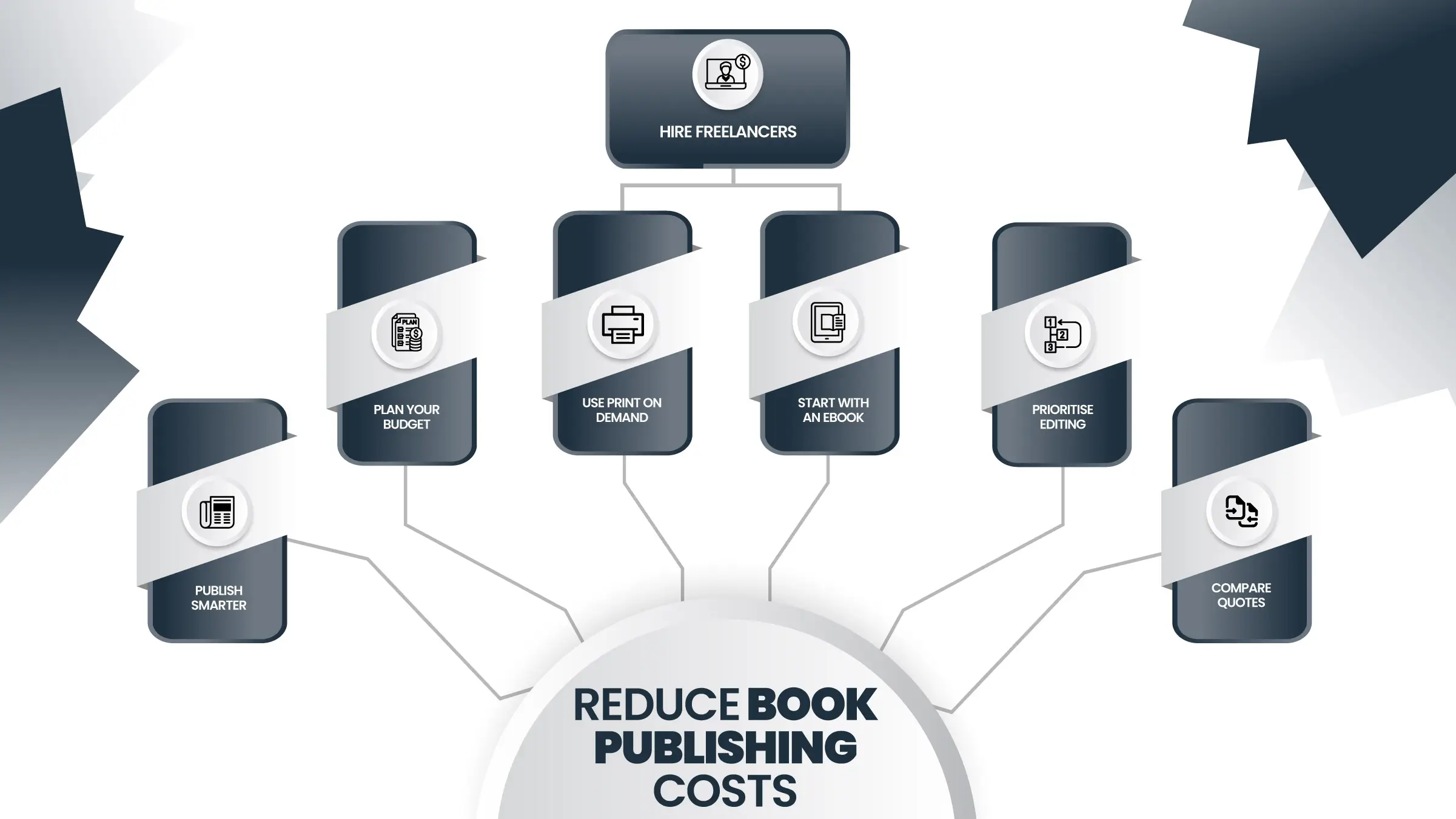
Here are some practical ways to lower your publishing costs while still producing a book that meets readers’ expectations.
Prioritise Professional Editing
If you can only afford one professional service, make it editing.
Before hiring an editor, revise your manuscript several times, use grammar-checking tools, and ask trusted beta readers for feedback. The cleaner your manuscript, the less time an editor needs to spend correcting it, which can reduce your editing costs.
When you’re ready, invest in professional book editing and proofreading rather than skipping this stage altogether.
Work with Freelancers
Instead of purchasing expensive publishing packages, consider hiring freelancers for individual services.
Platforms such as Fiverr and Reedsy allow you to compare editors, designers, and formatters based on experience, reviews, and pricing.
This approach lets you choose the services your book genuinely needs instead of paying for features you may never use.
Start with an eBook
If your budget is tight, consider releasing an eBook before investing in print editions.
Publishing digitally eliminates printing expenses and allows you to begin earning royalties before expanding into paperback or hardcover formats.
Many successful independent authors test reader demand with an eBook first and release print editions later.
Use Print on Demand
Rather than ordering hundreds of copies upfront, use Print on Demand through Amazon KDP or IngramSpark.
This allows books to be printed only after they’re purchased, helping you avoid:
- Storage costs
- Unsold inventory
- Large upfront printing bills
For most first-time authors, Print on Demand is the safest and most cost-effective publishing model.
Compare Quotes Before Hiring
Whether you’re looking for editing, design, or formatting, don’t accept the first quote you receive.
Compare several providers, request sample work, and clarify exactly what’s included before making a decision.
For example, if you need to have your book typeset by a professional, ask whether the quote includes revisions, print-ready files, and both paperback and eBook formatting.
Plan Your Marketing Budget
It’s easy to overspend on advertising before understanding which strategies actually work.
Instead of launching multiple paid campaigns immediately:
- Build an email list.
- Create an author website.
- Ask early readers for honest reviews.
- Focus on consistent promotion rather than one expensive launch.
These activities often provide stronger long-term value than relying solely on paid advertising.
Build a Publishing Budget Before You Start
One of the best ways to control costs is to create a publishing checklist before spending any money.
Ask yourself:
- Which services are essential?
- Which tasks can I complete myself?
- How much can I comfortably invest?
- Which expenses can wait until after publication?
Having a clear budget helps you make informed decisions instead of reacting to unexpected costs along the way.
Publishing professionally doesn’t mean spending the most, it means spending wisely. Investing in the areas that directly improve your book while avoiding unnecessary expenses will usually deliver the strongest return over time.
Is Publishing a Book Worth the Cost?
Yes, publishing a book can be worth the investment if it helps you generate royalties, build your author brand, attract new opportunities, or grow your business. The return often extends far beyond book sales alone.
Whether publishing a book is worth the investment depends on what success looks like to you. If your only goal is to recover your publishing costs quickly, the answer will vary from book to book. However, if you’re looking at the bigger picture, a professionally published book can deliver value long after its launch. Rather than viewing publishing as an expense alone, think of it as a long-term publishing investment in your author career.
I’ve found that many authors focus solely on the upfront expense and overlook the long-term opportunities a book can create. Beyond direct sales, a book can strengthen your reputation, attract new clients, open speaking opportunities, and establish your expertise in a particular field.
How Much Money Do Authors Make?
There isn’t a single answer because author income depends on several factors, including:
- Book pricing
- Royalty rate
- Publishing model
- Marketing strategy
- Audience size
- Number of books published
For example, self-published authors generally earn higher royalties per sale than traditionally published authors because they retain more control over pricing and distribution. However, they also cover most production and marketing costs themselves.
Traditional authors often receive lower royalty percentages, but publishers invest in editing, design, printing, and distribution, reducing the author’s financial risk.
Understanding the ROI of Publishing a Book
When considering the ROI of publishing a book, it’s important to think beyond book sales alone.
A professionally published book can help you:
- Build credibility in your industry
- Generate consulting or coaching opportunities
- Increase speaking invitations
- Grow your email list
- Promote your business or services
- Create additional income through future books
For nonfiction authors in particular, a book often acts as a marketing asset rather than a standalone product. Even if book sales only cover the publishing costs, the opportunities created by increased visibility can provide significant long-term returns.
When Publishing Makes Financial Sense
Publishing is more likely to become profitable when you:
- Publish multiple books instead of relying on a single title.
- Continue marketing after launch.
- Build an audience through newsletters and social media.
- Release books in multiple formats, such as eBook, paperback, and hardcover.
- Treat publishing as an ongoing business rather than a one-time project.
Many successful independent authors reinvest their early royalties into improving future books, gradually increasing both quality and revenue over time.
Publishing Is an Investment in Your Author Career
If you’re publishing solely to make quick money, it’s worth setting realistic expectations. Most books don’t become bestsellers overnight.
However, if your goal is to build an author brand, reach readers, or create a lasting body of work, publishing can be one of the most valuable investments you make.
Rather than asking whether publishing is expensive, ask yourself whether your investment is helping you produce a book readers will enjoy and recommend. That’s often what determines long-term success.
Real-Life Cost Examples
Real-world publishing costs vary depending on your goals and publishing strategy. The examples below show what you can realistically expect to spend on low-budget, professional, and premium publishing projects.
Example 1: Low-Budget Self-Publishing ($100–$500)
This option is ideal if you’re comfortable doing much of the work yourself.
| Expense | Estimated Cost |
| DIY editing | Free |
| Freelance proofreading | $100 |
| DIY cover design | Free–$50 |
| Formatting software | Free |
| Amazon KDP publishing | Free |
| Basic marketing | $50–$300 |
| Estimated Total | $100–$500 |
This approach keeps costs low but requires a significant investment of your own time. This is a realistic example of low budget book publishing that still produces a professional result when you invest your time wisely.
Example 2: Professional Independent Publishing ($1,000–$3,000)
Many first-time authors choose this budget because it balances affordability with professional quality.
| Expense | Estimated Cost |
| Professional editing | $800–$1,500 |
| Cover design | $250–$500 |
| Formatting | $150–$300 |
| ISBN | Free–$125 |
| Marketing | $300–$800 |
| Estimated Total | $1,500–$3,000 |
This budget typically results in a polished book that’s ready for commercial publication.
Example 3: Premium Publishing Project ($5,000+)
Authors launching business books, illustrated titles, or books intended for wide commercial distribution often invest more heavily.
| Expense | Estimated Cost |
| Developmental editing | $2,000+ |
| Copyediting and proofreading | $1,000+ |
| Premium cover design | $800+ |
| Professional formatting | $300+ |
| Marketing campaign | $2,000+ |
| Estimated Total | $5,000+ |
While this budget is considerably higher, it often includes extensive editing, professional branding, and a larger promotional campaign.
Which Budget Is Right for You?
The right publishing budget depends on your goals, experience, and available resources.
If you’re publishing your first book, don’t feel pressured to invest thousands of dollars immediately. Start with the services that have the greatest impact on quality, publish the best book you can, and reinvest your earnings into future projects.
Publishing is rarely about spending the most money. It’s about making thoughtful decisions that support your readers and your long-term author journey.
Start Publishing Your Book Today
Now that you know how much does it cost to publish a book, you’re in a much better position to plan your budget and publish with confidence. From what I’ve seen, the cost to publish a book isn’t about spending the most money. It’s about investing in the services that will have the biggest impact on your book and your readers.
The average cost of publishing a book will look different for every author because every publishing journey is different. Whether you choose to publish on a small budget or invest in a fully professional publishing process, careful planning will help you avoid unnecessary expenses and make smarter decisions.
If you’re ready to move forward, start with a realistic budget, focus on quality where it matters most, and publish a book you’re proud to share. Every successful author starts with a single step, and your publishing journey can start today.